
Performance Marketing vs Digital Marketing: Choosing the Best Strategy in 2026
An ultimate guide on “Difference between Performance Marketing vs Digital Marketing in 2026“ by the Academy of Web Technologies & Information Management
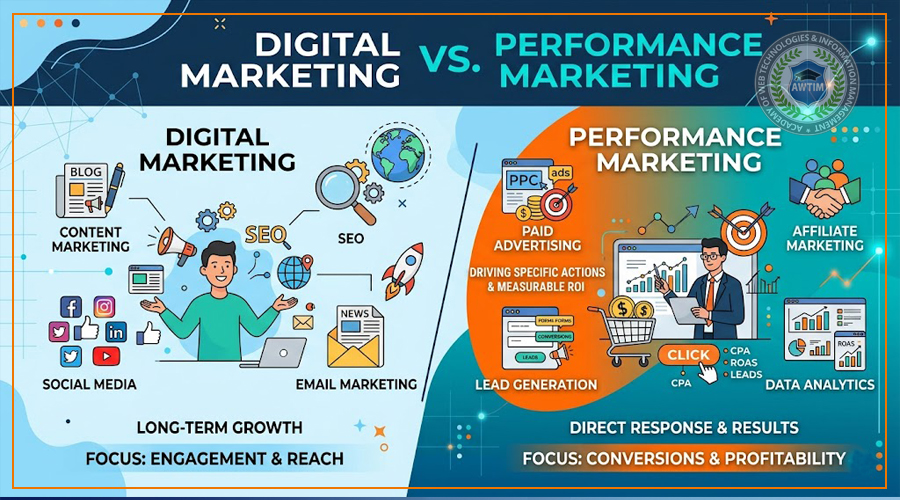
Digital marketing builds broad brand presence and trust over time. In contrast, performance marketing is a highly measurable subset focused strictly on generating immediate, ROI-driven sales and leads.
The business world is evolving at a breakneck pace, and as we navigate the complexities of 2026, the digital arena has never been more competitive. Businesses are constantly looking for the most efficient ways to reach their target audience, generate leads, and maximize revenue. Yet, there remains a persistent layer of confusion surrounding the terminology we use to define our online growth strategies. The most common debate among business owners and aspiring professionals alike is: Performance Marketing vs Digital Marketing. Navigating the intricacies of search engine algorithms, web analytics, and strategic campaign execution for over 12 years reveals a distinct pattern. The line between building a recognizable brand and driving immediate, measurable revenue is often misunderstood. Some businesses pour money into campaigns without knowing what to measure, while others focus so heavily on immediate clicks that they forget to build trust.
This comprehensive guide, exclusively brought to you by the Academy of Web Technologies & Information Management (AWTIM), will break down the exact differences, pros, cons, and synergies between performance marketing and digital marketing. Whether you are a business owner looking to scale or a student searching for the best performance marketing course in Kolkata, this article will equip you with the knowledge you need to thrive in 2026.
Decoding the Core Concepts
Before we compare the two, it is essential to understand that they are not entirely separate entities. Performance marketing is essentially a highly specialized subset of the broader digital marketing universe. However, the mindset, execution, and measurement of success for both are fundamentally different.
What is Digital Marketing in the 2026 Landscape?
Digital marketing is the overarching umbrella that encompasses every single online effort a brand makes to connect with current and prospective customers. It is a holistic approach focused on brand building, audience engagement, education, and long-term authority.
In 2026, digital marketing is less about shouting your message and more about creating a seamless user experience. It involves a multitude of channels and strategies:
- Search Engine Optimization (SEO): The backbone of organic visibility. Today, this goes far beyond basic keywords. It involves deep technical SEO audits, implementing advanced schema markup to help search engines understand context, and building topical authority through high-quality content.
- Content Marketing: Crafting valuable, relevant, and consistent content—ranging from informative medical blog articles for healthcare professionals to engaging video scripts for real estate portals—to attract and retain a clearly defined audience.
- Social Media Marketing (SMM): Building a community and fostering relationships on platforms where your audience spends their time.
- Programmatic SEO (pSEO): A rising trend in 2026, pSEO involves creating thousands of high-quality, intent-driven landing pages dynamically to capture hyper-local and long-tail search traffic at scale.
- Web Architecture & Experience: A digital marketing strategy is only as strong as the website it directs people to. Custom WordPress development, specifically tailored plugins, and lightning-fast loading speeds are non-negotiable components of a modern digital strategy.
The Goal of Digital Marketing: To establish brand equity, nurture trust, educate the consumer, and create a lasting digital footprint that pays dividends over years, not just days.
What is Performance Marketing?
If digital marketing is the entire ocean, performance marketing is a highly targeted spear-fishing expedition. Performance marketing is a rigorous, data-driven approach where advertisers only pay when a specific, predefined action occurs. This action could be a generated lead, a completed sale, a downloaded whitepaper, or a booked appointment.
Unlike traditional digital marketing campaigns where you might pay a flat fee for ad placement or content creation with the hope of gaining traction, performance marketing flips the script. It is strictly ROI-focused. You are paying for results, not just reach.
Key components include:
- Cost Per Acquisition (CPA) & Cost Per Lead (CPL): The guiding metrics. Every campaign is meticulously optimized to lower the cost of acquiring a paying customer.
- Pay-Per-Click (PPC) Advertising: Running targeted ads on Google or Bing where your budget is only spent when a user actively clicks on your link.
- Social Media Advertising: Utilizing advanced targeting algorithms on Meta, LinkedIn, or YouTube to show ads strictly to high-intent demographics.
- Conversion Rate Optimization (CRO): Relentlessly A/B testing landing page designs, ad copy, and calls-to-action to ensure that the maximum number of visitors take the desired action.
The Goal of Performance Marketing: Immediate, measurable, and scalable return on investment (ROI). It is about putting $1 into a machine and predictably getting $3 back.
A Detailed Breakdown between Performance Marketing vs Digital Marketing
To truly grasp “Performance Marketing vs Digital Marketing,” we must analyze them across several critical dimensions. Neither is inherently better; rather, they serve entirely different stages of the business lifecycle.
A. Primary Objective and Focus
- Digital Marketing: Focuses on the “Why” and the “Who.” Why should the customer care about your brand? Who are you as a company? The objective is to build a narrative, foster loyalty, and create top-of-mind awareness.
- Performance Marketing: Focuses purely on the “What” and the “When.” What action do we want the user to take, and how can we get them to take it now? The objective is immediate lead generation and sales.
B. Payment Models and Risk
- Digital Marketing: Usually involves upfront investments. You pay for an SEO strategist to optimize your site, a developer to enhance your WordPress architecture, or a writer to draft high-quality blogs. The risk is higher because the financial return may take months to materialize.
- Performance Marketing: Operates on performance-based pricing models (CPC, CPL, CPA). The risk is technically lower regarding ad spend because you only pay when an action occurs. However, it requires a high budget for testing and constant monitoring to prevent wasted ad spend on unqualified clicks.
C. Time Horizon for Results
- Digital Marketing: It is a marathon. Strategies like building organic topical authority or climbing search engine rankings through technical optimization can take 3 to 6 months to show significant traction. However, once established, organic traffic provides the highest long-term ROI.
- Performance Marketing: It is a sprint. A well-crafted ad campaign can start driving traffic, leads, and sales within hours of launching. The caveat? The moment you turn off your ad budget, the traffic instantly stops.
D. Measurement and Analytics
- Digital Marketing: Success is measured through a blend of metrics: organic traffic growth, time spent on page, bounce rate, social media engagement, and brand mentions. These metrics indicate brand health but don’t always tie directly to a dollar amount immediately.
- Performance Marketing: Success is ruthlessly binary. Metrics are strictly financial and action-oriented: Conversion Rate, Return on Ad Spend (ROAS), and Cost Per Acquisition. If a campaign is not profitable, it is immediately paused or optimized.
Real-World Business Scenarios: How to Choose in 2026
Choosing between these strategies—or more accurately, deciding how to balance them—depends entirely on your current business goals, cash flow, and industry. Let’s look at some practical applications.
Scenario 1: The Fast-Paced Aggregator Platform
Consider a newly launched real estate portal aiming to aggregate property listings across India and connect buyers with property experts.
- The Performance Need: The platform needs immediate traction. To prove the business model and satisfy property listers, they must generate immediate buyer inquiries. Performance marketing (Google Search Ads targeting “buy flat in [city]”, Facebook Lead Gen ads) is deployed to drive instant, trackable leads.
- The Digital Marketing Need: Simultaneously, relying purely on ads is expensive. To build a sustainable brand, the portal must invest in digital marketing: creating engaging video scripts featuring property experts, drafting comprehensive neighborhood guides for SEO, and optimizing their site structure. Over time, the digital marketing efforts will reduce the reliance on paid performance marketing.
Scenario 2: The Specialized Professional Service
Think about specialized medical professionals in Kolkata, such as cardiologists or urologists, looking to expand their private practice.
- The Digital Marketing Need: Patients choosing a doctor require immense trust. Digital marketing is vital here. Maintaining an updated Google Business Profile, publishing informative medical blog articles about heart health or treatments, and ensuring the doctor’s website has a clean, fast, and accessible layout builds unparalleled authority and patient trust.
- The Performance Need: To fill short-term appointment gaps, hyper-local performance marketing ads targeting search terms like “best cardiologist near me open now” ensure that high-intent patients find the clinic precisely when they need immediate care.
The Verdict for 2026: You cannot survive on one alone. Performance marketing pays the bills today, while digital marketing builds the empire for tomorrow. A robust strategy integrates both, using the immediate data gathered from performance campaigns to inform the long-term content and SEO strategies of the digital marketing side.
Why 2026 Demands Specialized Skills
The days of generic “marketing” are over. The platforms have become too complex, the algorithms too intelligent, and the competition too fierce. In 2026, the industry is seeing a massive shift toward automation, AI-driven analytics, and strict data privacy regulations.
To execute these strategies successfully, professionals must understand:
- Advanced Data Tracking: Knowing how to implement server-side tracking and configure complex regex patterns in Google Search Console to monitor precise user behavior.
- Technical Ecosystems: Understanding how web development directly impacts marketing. If a landing page takes more than 2 seconds to load, your performance marketing budget is being wasted.
- Strategic Resource Allocation: Knowing exactly when to pivot budget from a top-of-funnel brand awareness campaign to a bottom-of-funnel retargeting campaign.
This increasing complexity has led to a massive surge in demand for highly trained professionals who understand both the creative side of digital marketing and the mathematical rigor of performance marketing.
Launching a Thriving Career in Kolkata
With the rapid digitization of local businesses, healthcare sectors, real estate, and retail, Kolkata has emerged as a booming hub for digital marketing professionals. Companies are no longer looking for basic social media posters; they are actively hunting for strategists who can prove ROI and manage complex web architectures.
If you want to capitalize on this industry growth, specialized training is non-negotiable. Many students and working professionals spend hours searching for the best performance marketing course in Kolkata to upgrade their skill sets.
What to Look for in a Training Program
When evaluating Performance marketing training in Kolkata, theoretical knowledge is simply not enough. The industry demands practical, hands-on experience. A premium training institute should offer:
- Live Project Experience: You must run actual campaigns, analyze real data, and understand how to optimize real ad spend.
- Comprehensive Curriculum: The course should bridge the gap between technical web infrastructure (like HTML/CSS and WordPress) and advanced marketing strategies (SEO, SEM, SMM).
- Industry-Expert Mentorship: Learning from professionals who have spent years in the trenches, auditing sites, and managing client budgets provides insights you cannot find in free online tutorials.
Many prospective students also worry about the financial investment. When researching performance marketing fees in Kolkata, it is vital to view it as an investment in a high-paying, future-proof career. The ROI on a quality education in this sector is exceptionally high, given the lucrative starting salaries for skilled analysts and strategists.
Master the Future with AWTIM
At the Academy of Web Technologies & Information Management (AWTIM), we understand exactly what the industry demands in 2026. Since 2014, we have been Kolkata’s premier IT and Digital Marketing training institute, dedicated to transforming freshers, business owners, and professionals into industry-ready experts.
If you are ready to master the intricacies of both brand building and ROI-driven campaigns, our Advanced Digital Marketing Course is meticulously designed for you.
The AWTIM Advantage
Our 5-6 month comprehensive program goes far beyond the basics. We ensure you are fully equipped to handle the challenges of the modern digital landscape:
- Holistic Curriculum: Master Digital Marketing Strategy, On-page SEO (including deep-dives into HTML/CSS/WordPress integration), Off-page SEO, Social Media Marketing (SMM), and Search Engine Marketing (SEM).
- 100% Assured Placement Assistance: We don’t just teach; we guide you into the workforce. Our strong industry connections ensure our successful candidates get the best interview opportunities.
- Practical Grounding: Engage in LIVE project training where you apply concepts to real-world scenarios, preparing you for the complexities of agency and corporate roles.
- Flexible Learning Environment: Choose between online and offline classroom modes, complete with well-equipped infrastructure and one-on-one guidance.
Whether you want to drive leads for your own business or build a lucrative career managing high-budget campaigns for global clients, AWTIM provides the foundational knowledge and the advanced tactics required to succeed.
Take the Next Step in Your Career Today!
Don’t let the complexities of the digital world hold you back. Learn from experienced industry professionals and secure your future in one of the world’s fastest-growing sectors.
For admissions, course details, or to book a free demo class, reach out to us directly:
Call or WhatsApp: +91 8961235337
Visit us: 2790, Deodhar Place, Near Khudiram Metro Station, Garia, Kolkata, West Bengal 700084.
Why AWTIM is the Best Institute for Performance Marketing Course in Kolkata?
Finding the right mentor is critical. Here is why AWTIM stands out as an industry leader:
-
Strictly Classroom Learning: Get your doubts solved instantly. Face-to-face learning ensures you actually understand complex topics like Server-Side Tracking and Target ROAS.
-
Agency-Level Mentorship: Learn from practitioners who actively manage large-scale daily ad spends.
-
Real-World Projects: You won’t just study theory; you will build campaigns on live platforms.
-
Dedicated Support: Backed by our trusted reputation at awtim.com, we provide interview prep, resume building, and dedicated placement assistance to launch your career.
Frequently Asked Questions on Performance Marketing vs Digital Marketing:
Can I do performance marketing without doing digital marketing?
Technically, yes. You can run a standalone Google Ads campaign (performance) without having a blog or social media presence (digital). However, in 2026, user trust is paramount. Without a solid digital marketing foundation (a good website, brand reviews, organic presence), your performance marketing ad costs will be significantly higher because users are less likely to convert if they don’t trust the brand.
Which strategy is more cost-effective for a startup?
Startups often need quick cash flow to survive. Therefore, a lean performance marketing strategy targeting high-intent keywords is usually the best starting point to generate immediate revenue. Once cash flow stabilizes, profits should be reinvested into digital marketing (SEO and content) to lower acquisition costs over time.
Does AWTIM provide practical training on these concepts?
Yes. At AWTIM, we believe in hands-on learning. Our Advanced Digital Marketing and Internet Marketing courses include LIVE project training, allowing students to execute SEO, SEM, and SMO strategies in real-world scenarios, ensuring they are job-ready from day one.
What is the difference between Performance Marketing vs Digital Marketing?
Digital marketing is the general term for advertising your business online through channels like social media, emails, and search engines. Performance marketing is a specific, results-focused type of digital marketing where you only pay when your ads actually work. Instead of spending money just to show your ad to people, you only pay when someone takes a clear action, like clicking a link, signing up, or buying a product.
Disclaimer: This blog and all its contents are protected by copyright, owned entirely by Academy of Web Technologies & Information Management (AWTIM). We strictly prohibit the use, duplication, or transmission of any text, screenshots, or featured imagery for commercial or non-commercial purposes without obtaining direct, written permission from an authorized representative of our company. Legal action will be taken against any unauthorized use.
Read Also:
- Best Performance Marketing Course in Kolkata in 2026
- Top 10 computer courses in Kolkata for 2026 in Demand – Complete Guide
- SEO glossary: 60+ SEO terms and definitions for 2026
- Easy tutorial to make WordPress website with SEO Friendly URL structure
- The Importance of Keeping Your Web Development Skills Up-to-Date in 2025
- Understanding the Differences between Web Design and Web Development
- The Importance of HTML, CSS, and JavaScript in Web Development
- Tips for Learning Web Design and Development Online 2025
- The 10 Most Career-Oriented Institutes for Full Stack Education in Kolkata 2025
- Digital Marketing Course in Kolkata 2025: Syllabus, Fees, Duration, Jobs, Freelancing
Follow us on Youtube & Facebook
About Author
